


Supporting employee wellbeing at work is good for your people and your organisation. Ensuring you have the right tools and resources in place to promote wellbeing can prevent stress and create great work environments where people can thrive and flourish.
For managers, leaders and HR teams, promoting wellbeing is a fundamental part of the job. However, for neurodivergent and disabled colleagues, you may need to adapt your approach to ensure you support everyone’s wellbeing at work.
In this blog we’ll explore what wellbeing is, triggers in the workplace, how triggers may affect neurodivergent and/or disabled colleagues, and how Line Managers and HR can support – one techniques which we’ll look at is pacing better support self-management.
What is Wellbeing?
Wellbeing can refer to various aspect of life, including social wellbeing, physical wellbeing, economic wellbeing and emotional wellbeing.
At work, we often need to think about our mental wellbeing. Mental wellbeing is the ability to cope with day-to-day stresses of life, work productively, interact positively with others and realise our own potential.
Workplace Triggers affecting Mental Wellbeing
There are lots of common workplace triggers that can affect mental wellbeing. These can include:
- working long hours and no breaks
- unrealistic expectations or deadlines
- overly pressurised working environments
- unmanageable workloads or lack of control over work
- inability to use annual leave
- a poor physical working environment
- difficult interpersonal relationships
- poor internal communication or a lack of managerial support
- poorly managed change
For disabled and/or neurodivergent people, there can be further triggers which can compound poor wellbeing including:
- the inability to control sensory input in the workplace
- requirement to mask (attempting to conceal neurodivergent traits to appear neurotypical at work)
- poor interoception leading to overwork (inability to pick up on the body’s cues that indicate fatigue, hunger or thirst)
- lack of understanding and support
- communication differences
This list is, of course, not exhaustive!
Why might neurodivergent and/or disabled staff members need wellbeing support?
As above, neurodivergent and/or disabled staff may face additional factors that affect their wellbeing at work.
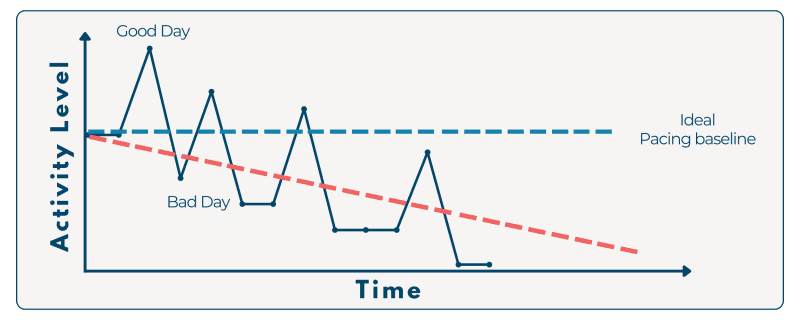
In addition to this, some may also experience a ‘boom and bust’ cycle at work. This is where they use all their energy by having periods of very high productivity followed by periods of exhaustion.
The above picture illustrates this ‘boom and bust’ cycle.
People may get into this cycle for many reasons, including wanting to please others or forcing themselves to work in a way that doesn’t suit them due to prevailing cultural norms.
This cycle, over a long period of time, can lead to burnout. Burnout is very serious and can take many years for someone to recover from. People who are experiencing burnout often have extreme exhaustion and a sense of overwhelm. It is caused by continuous periods of stress, overstimulation, having to meet high demands and even extended masking.
Neurodivergent people are often at high risk of experiencing burnout as the world around them can exacerbate their feelings of stress and overstimulation. Similarly, people who mask can be at a higher risk of burnout as they may not have enough support, adjustments or breaks to manage their stress.
This means it is vital to get wellbeing right for these groups to ensure they are able to thrive at work.
Pacing systems are one of the things that can support someone to get out of the boom and bust cycle.
Pacing: a Tool for Supporting Neurodivergent and Disabled Colleagues
If you are supporting or line managing a neurodivergent or disabled person, you may want to consider looking into pacing as a technique to help support self-management.
Pacing was originally developed for people who experience chronic health conditions but, it is increasingly being used to support neurodivergent people too. The idea is that people even out how they use energy on different tasks throughout the day. By pacing, people can create a more sustainable lifestyle where they have more control over their activities.
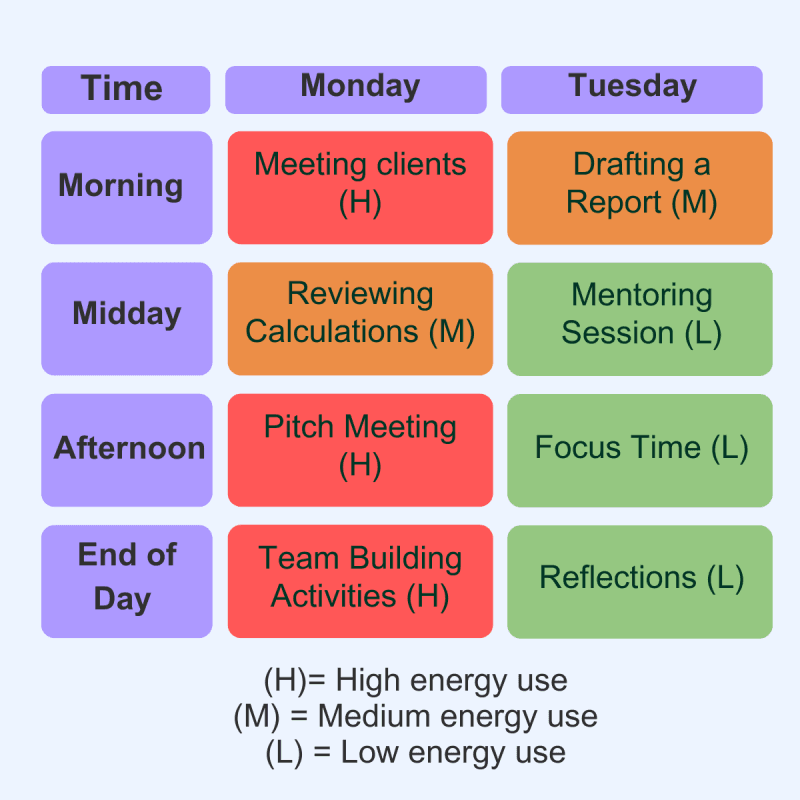
To get started, try encouraging your direct report to keep a weekly activity diary and colour code the different activities for the amount of energy it uses. You can then review the diary with them to see where they are using the most energy. By looking at the patterns, you can help your team member to balance out activities which are highly tiring with activities that are more restful.
For example how can the two days in the image be more balanced?
Image text reads:
| Monday | Tuesday | |
| Morning | Meeting Clients (H) | Drafting a Report (M) |
| Midday | Reviewing Calculations (M) | Mentoring Session (L) |
| Afternoon | Pitch Meeting (H) | Focus Time (L) |
| End of Day | Team Building Activities (H) | Reflections (L) |
(H) = High energy use (M) = Medium Energy Use (L) = Low Energy Use
What else can be done to support wellbeing?
You can also look at some more general tips for workplace wellbeing that will support everyone too!
Some key tips include:
- Facilitate Regular Breaks – Some people, particularly those who hyperfocus, may find taking breaks hard. However, taking small breaks from a task is proven to reduce stress, keep people more engaged in the long run and make the experience of work more enjoyable. Ensure leaders role-model taking breaks and encourage staff to do so, providing ideas or suggested break structures.
- Make Sure Employees Disconnect – Encourage your teams to disconnect at the end of the day. Ensure senior leaders role model this and show team members that it is okay to pack away the laptop at the end of the day. If some people are working flexibly, it can be helpful to highlight this in their email signature so people don’t feel pressured to respond outside of their own working hours.
- Wellbeing Actions Plan – You can use various tools, often called Wellbeing Actions Plans, to help identify what is causing reduced wellbeing. These are typically a set of guided questions that help you and a direct report work through their situation to identify where changes can be made to support wellbeing. A good example of this template can be found through the charity, Mind, for both line managers and employees.
- Provide Support for Physical Health – Lack of sleep, poor eating habits and sitting at a screen all day can increase stress. Encourage your teams to engage in movement throughout the day. This could be in the form of gentle stretching resources or having employee benefits that provide discounts or access to local exercise facilities.
- Support When Help is Needed – Some people may need more professional support with supporting their wellbeing. Ensure you have resources on hand for signposting and make sure colleagues know where to find them.
Workplace Needs Assessments
You may also want to get expert advice to support your neurodivergent and/or disabled colleagues. Looking into a Workplace Needs Assessment can be a comprehensive way to get guidance on techniques and tools that can be used to support someone in the workplace. This includes ways to ensure they are looking after their wellbeing at work.
A Workplace Needs Assessment is a conversation between an employee and a trained Assessor. The Assessor will explore what their working day looks like as well as their role and responsibilities and the strengths and challenges they face at work.
After the Assessment, your employee will receive a report of recommendations with an explanation of why they have been suggested and how they might help. With their consent, the report can be shared to your organisation who can make the changes needed to support the person at work, improving wellbeing.
You can fund a Workplace Needs Assessment privately or you may be able to use the government-funded scheme, Access to Work.
If you have any questions about Workplace Needs Assessments, get in touch with us and we’ll be happy to help! You can email us at commercial@neurobox.co.uk for private assessments or at atw@neurobox.co.uk if you want to use Access to Work.
If you’ve already had a Workplace Needs Assessment reach out to our team at atw@neurobox.co.uk and we’ll be able to supply all your recommendations – this means one supplier so it simplifies the process for you and your organisation.
About the author

Bronwyn has previously worked in a wide range of sectors – both private and public – including technology, telecoms and robotics in roles across Business Partnering, Learning & Development and Reward.
Bronwyn is an experienced Employee Disability Network Lead and they enjoy mentoring and supporting other late-diagnosed autistic people.
For the past 3 years, they have been working with Coventry University and Sussex University to support research into how disabled and/or neurodivergent people experience remote work.
Related readings

